
BLOG
More utilisation for your charging points – with the chargecloud Data Dashboards
What defines a successful charging infrastructure? A good question – one that every charging point operator should ask at least once. At first glance, the answer seems simple: a good location, ideally at key junctions, easily accessible parking lots, or high-traffic roads. Certainly not wrong are answers like “a roof,” “access to restrooms and restaurants,” or “a park to pass the charging time.” These so-called Points of Interest (POI) can determine whether a charging point enjoys high utilisation or sits idle in isolation. But how much influence do these individual location factors really have? To distinguish between gut feeling and hard facts, to understand charging infrastructure, plan intelligently, and scale not just quantitatively but qualitatively, clean data is essential. Or, to put it another way: what’s better – one good location or two bad ones?
Especially in such a young industry as e-mobility, data and analyses based on representative sample sizes are still a rarity. In this article, we explore why utilisation, location advantages, and data access are so crucial – and how chargecloud’s new Data Dashboards can provide the decisive tool.
Gut feeling vs. evidence – utilisation as an indicator
As charging infrastructure expands, competition for the best locations intensifies. Whether municipal utility, energy supplier, or full-service provider – anyone operating, scaling, or entering the e-mobility business faces the same challenge: to be successful in the long term, transparency about the actual performance of one’s charging points is key.
Many decisions are still made today based on intuition, experience, or isolated – and often barely representative – analyses. Yet concrete data and real-time insights into current statistics often tell a very different story.
In 2025, we analyzed and evaluated more than 23,000 charging points and 8,000 locations with a total of over 5.5 million charging sessions for the first time. The result: average utilisation stands at just 8 percent. Locations achieving 15 percent utilisation are already performing better than 84 percent of charging points on the market.
Utilisation here describes how intensively a charging station is actually used – that is, the ratio of occupied to available charging time. The higher the utilisation, the more economically efficient the charging point. Based on this data, it becomes clear what distinguishes a top-performing station. Even small optimizations at underutilized locations—such as adding a roof or service offerings – can make the difference between success and failure.
A new level of transparency – the chargecloud Data Dashboards
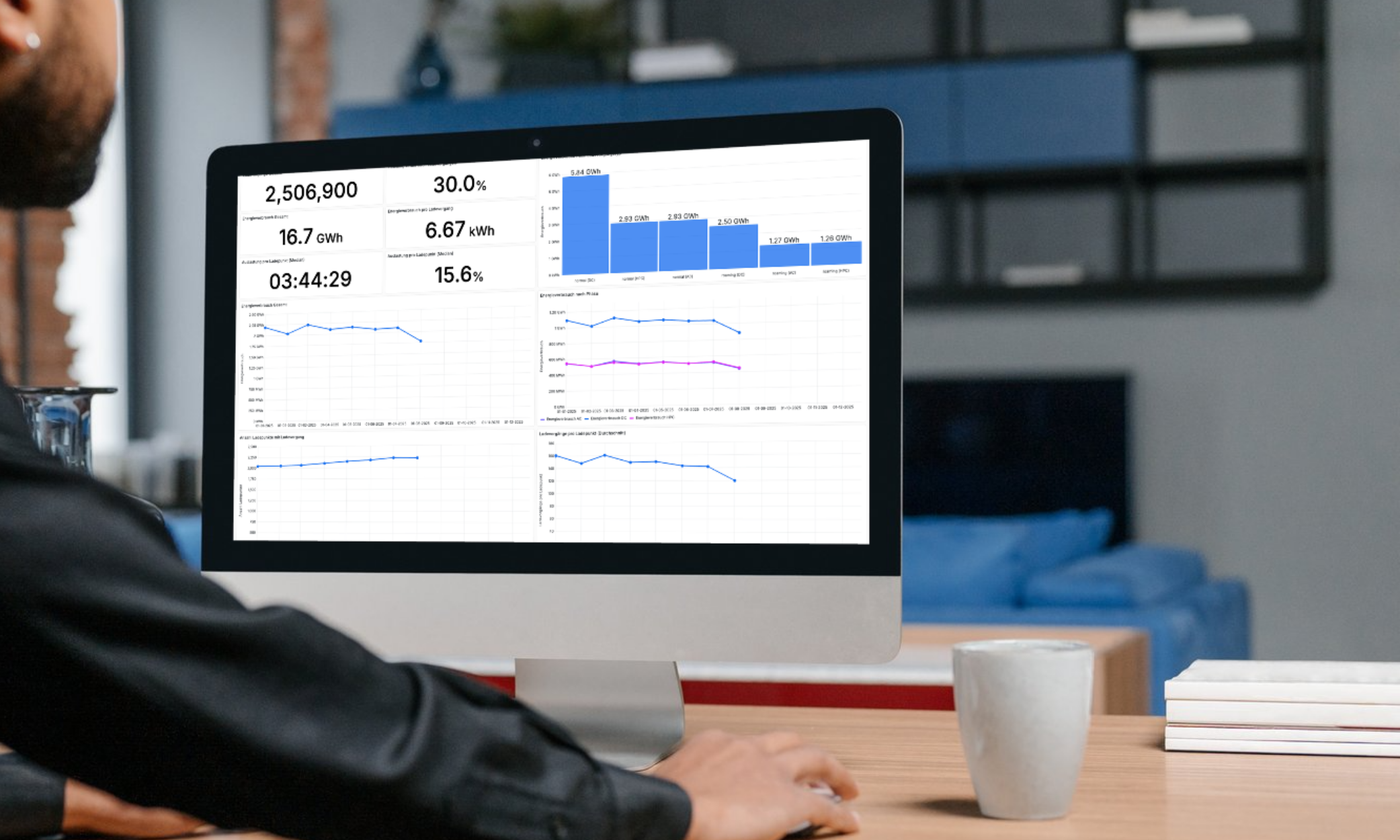
To turn data into insights, you need more than endless tables and columns of numbers. With its new state-of-the-art Data Dashboards, chargecloud provides a tool that not only evaluates charging infrastructure performance but also makes it visible at a glance.
The dashboards act as a strategic cockpit: they consolidate all relevant key figures and show operators where their charging points really stand – both literally and figuratively. The goal is to promote data-driven decision-making and make operational excellence measurable. If one charging point performs better than another, these insights can directly inform decisions about new locations.
At their core, the new Data Dashboards offer four perspectives on your business:
- Utilisation overview: See how well your infrastructure is performing overall, with time trends, weekly heatmaps, and top-location rankings.
- Location utilisation: Provides a detailed view of individual sites, including metrics such as roaming share, energy consumption, and average charging times.
- Charging infrastructure & core KPIs: Offers a comprehensive overview of development, consumption, and charging sessions – including year-over-year comparisons. Ideal for internal reporting or strategic planning.
- Charging sessions & energy consumption: Analyzes in detail when, where, and how much energy flows – broken down by phases (AC, DC, HPC), charging points, or charging types (e.g., ad hoc, roaming, or contract-based).
All dashboards are built on a modern architecture that ensures data security, GDPR compliance, and stability – even as network size and data volumes grow.
The basic version of the Data Dashboards is available free of charge to all our customers, because we believe: when charging infrastructure is operated more intelligently, everyone benefits – operators, e-mobilists, and the energy transition alike. Together, we are shaping a sustainable, data-driven future of mobility.
Strategic advantages in practice
How data-driven decisions can make a difference in practice is shown by the results of our extensive 2025 analysis. Three key insights illustrate the value of data-based evaluation:
- Quality Beats Quantity: Top locations record on average eight times more charging sessions than low-performing ones. Knowing which sites truly perform allows for targeted investment instead of blanket expansion – quality over quantity.
- Proximity Drives Demand: Highly frequented charging points are almost always located near Points of Interest (POI) – places where e-mobilists already spend time: supermarkets, restaurants, leisure facilities.
- Accessibility Matters: The data shows that the shorter the walking distance between parking space and POI, the higher the utilisation. This enables operators to optimize planning not only geographically but also from a user-centric perspective.
These insights demonstrate how valuable a data-based understanding of one’s charging infrastructure can be. The Data Dashboards provide the foundation—making data comparable and translatable into actionable recommendations.
Growing through data – kWh by kWh
The future of charging infrastructure will not be decided solely in parking lots. Data analysis will play a crucial role as well. Those who understand why and when charging points are used can improve purposefully rather than act by chance. This is exactly where the chargecloud Data Dashboards come in: they transform complex operational data into clear insights and give operators a tool to make strategic and economic decisions—a competitive advantage over those who focus on quantity instead of quality.
Data-driven projects not only lead to higher utilisation but also to more sustainable growth. A top-performing charging station is used up to eight times more frequently than a weak one. The formula for success is therefore: quality over quantity – to scale smartly in the long term and offer e-mobilists a pleasant charging experience based on their actual behavior.